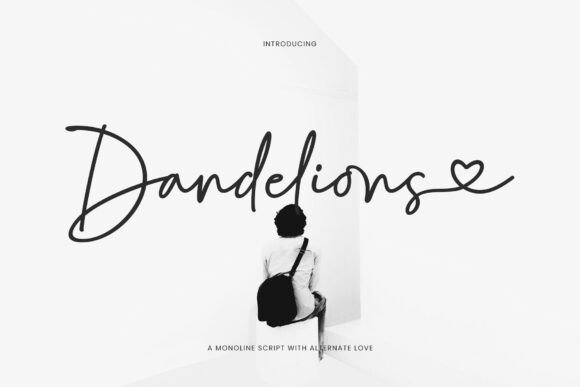
Dandelions: The Script Font That Feels Like a Handwritten Note
There’s a certain magic in the way a word feels when you write it by hand. It’s personal, a little imperfect, and carries a piece of your personality. In the digital world, achieving that intimate touch can be a challenge. We often default to clean, geometric fonts that, while professional, can sometimes feel sterile. This is where a typeface like Dandelions enters the conversation—not as just another script font, but as a bridge between digital precision and human warmth.
At its core, Dandelions is a refined monoline script. Think of it as the elegant cousin of casual handwriting. The strokes are consistent in weight, creating a smooth, flowing rhythm without the heavy thick-thin contrast of traditional calligraphy. The curves are balanced and deliberate, offering a polished, almost dance-like quality. It’s this balance that gives it a dual personality: it’s friendly and approachable, yet possesses an inherent sophistication. It doesn’t scream for attention; it whispers with confidence, making it a versatile asset in a designer’s toolkit.
Where Dandelions Truly Shines: Beyond the Wedding Invite
The immediate association for many script fonts is wedding stationery. And yes, Dandelions is a natural fit there—its gentle flow and handmade feel are perfect for wedding invitations, place cards, and thank-you notes. But limiting it to that niche would be a disservice to its range. This premium font excels in contexts where you need to inject personality and approachability into a brand or project.
For logo design, particularly for boutique businesses, artisanal products, or personal brands, Dandelions can become the cornerstone of a visual identity. Imagine it on a logo for a local bakery, a florist, or a lifestyle coach. It instantly communicates care, craftsmanship, and a personal touch. In packaging design, it can transform a simple label into something that feels curated and special, telling a story of quality before the customer even opens the box.
Digital spaces are equally receptive. On social media graphics, a quote or a call-to-action set in Dandelions can stop the scroll, feeling less like an ad and more like a message from a friend. For editorial design, it can be used sparingly for pull quotes, chapter headings, or magazine titles to add a touch of elegance and break the monotony of body text. Even in web design, it can be used strategically for hero section headlines or key phrases to draw the eye and establish a brand’s tone, provided it’s paired with a highly legible body font.
The Practical Guide: Using Dandelions with Purpose
Choosing a creative font is only half the battle; using it effectively is what separates good design from great. Here’s how to approach Dandelions with a strategist’s mindset.
1. Evaluate the Project Fit. Ask yourself: does my project need to convey warmth, personal connection, or artisanal quality? If you’re designing for a corporate law firm or a tech startup focused on data security, Dandelions might not be the right primary typeface. Its strength lies in human-centric narratives. Use it for brands that want to feel seen, heard, and understood.
2. Master the Font Pairing. This is critical. A script font like Dandelions should rarely be the workhorse for long paragraphs. Its power is in the headline. Pair it with a clean, neutral sans serif font or a traditional serif font for body copy. For example, Dandelions for a headline paired with a font like Lato or Open Sans for body text creates a beautiful hierarchy—the script draws you in, and the sans serif delivers the information clearly. This pairing is fundamental to modern typography and ensures both impact and readability.
3. Mind the Context and Readability. At very small sizes or on low-resolution screens, the fine, connected strokes of any handwritten font can become muddy. Test it. If you’re using it for a website headline, ensure it’s large enough to be crisp. For print, check the quality on the intended paper stock. Avoid using it for critical information like legal disclaimers or complex instructions where clarity is paramount.
4. Leverage Its Stylistic Strengths. Dandelions isn’t a one-trick pony. Most quality script fonts come with stylistic alternates, ligatures, and swashes. Explore these. A slightly different initial ‘S’ or a flowing connection between certain letters can make your text look more authentic and less like a default setting. This is where you move from using a font to crafting typography.
5. Understand the Licensing. As a commercial font, Dandelions comes with a license that dictates how you can use it. Before purchasing for a client project or a product you intend to sell (like on merchandise or a template), read the End User License Agreement (EULA) carefully. Knowing whether it covers desktop, web, and app usage, and for how many users, prevents legal headaches down the line. It’s a small step that protects your investment and your client’s project.
In the end, fonts like Dandelions are more than just design assets; they are tools for emotional connection. They allow you to build a brand identity that feels human, to create marketing materials that resonate, and to design publications that invite readers in. Used thoughtfully, it doesn’t just write words—it gives them a voice. It transforms a simple message into a personal invitation, adding that elusive layer of charm and character that makes a design truly memorable.